Been busy with some last details over the past few days. Me and Rachel have met up to discuss what last things need doing and sorted out a to do list for ourselves.
Mine was to:
@ finish sky dive test animation (done)
@ write an 'about me' for documentation (done)
@ Sort out a folder containing everything we want on a CD for the hand in. (done but still needs video diaries)
@ Make the images for our pitch presentation slides (done)
@ Make video diary
Here are the 3 images I've done for the presentation. We're not putting together slides with writing because it's only a 2 minute pitch, half of which will be our animatic. This just puts up something to look at while we're talking and hopefully having something visual will help the audience understand the idea.
Going to put them into a powerpoint unless Rachel thinks there's a problem.
Here is the final sky dive test animation:
Rachel's Blog
Showing posts with label Presentation. Show all posts
Monday, 4 June 2012
Tuesday, 6 March 2012
Psychological Gestures: The Presentation
Did the presentation today, it seemed to go well. I only hope that what I said made sense to the class and that the presentation was ok.
I noticed that the other presentations had a lot of images and while I normally would put much more in mine, I intentionally left them out. My original idea was to pose Malcolm in various gestures for the back drop, however I realised that they were not specifically psychological gestures, just body language. And while psychological gestures are a part of body language, it's rather specific so I left it out in fear of confusing the subject.
Anyway, my presentation:
I copied my notes under each slide to give a rough idea of what I was saying. Also, for some reason, the video clips I inserted into the presentation refused to stay put so those slides are blank. I'll put the video clips under those slides.
MICHAEL CHEKHOV
#First person to coin the term and teach psychological gestures.
#Developed from Stanislavski's lessons on Method Acting.
#Defined character psychology as thoughts, feelings and the will (objectives and motivation).
ACTORS
#Method of preparation. 'Heart is broken' exercise by Ed Hooks.
ANIMATORS
#Tend to over-gesture (guilty!) By using the same exercises, we can get into the character and tone down the gestures.
ATMOSPHERE
#Affects gestures a character makes. Different places = different atmospheres. Car crash scene vs. your best friend's kitchen.
#People have different atmospheres. Happy vs. Angry.
RELATIONSHIP
#Jack Napier - Carl Grissom's (crime boss) second in command. Jack having affair with Carl's mistress.
BEFORE
#Jack was sent to raid chemical factory by Carl. Carl set him up to be arrested by tipping off police. Deflected bullet from Batman caused Jack to fall into chemical vat.
PRESENCE
#Large, threatening, confident. Hand behind back - power position - opens airway = more energy.
GESTURE
Flick of arm. Like crack of whip, wants it to sting like it stung Jack to be put beneath a woman. Allows himself to indulge in his rage. Intentional?
RELATIONSHIP
#Bo-Peep is Woody's love interest. Feelings are mutual. Woody and Buzz are rivals for Andy's affection.
BEFORE
#Andy has started playing more with Buzz and Woody is starting to feel replaced. He has just spent the night in the toy box instead of on the bed, where the favourite toy usually sleeps with Andy, as he had done until now.
PRESENCE
#Small. Woody is a Sheriff and lives up to that. Looks after the other toys and makes sure things run smoothly. Out of date compared to Space Ranger. Loss of influence and significance.
GESTURE
#Fluster of hands. Looks for place to put hands, cannot complete a gesture = cannot complete a thought process. Reveals fluster of mind. Caught off guard, does not want Bo-Peep to see him weak. No control over situation reflected by no control of himself. Cannot control Andy's love.
Not very similar other than:
RIVALS
#Watch two different characters deal with a rival. Woody does not deal very well, cannot cope with replacement. Fails to deal with Buzz successfully until he accepts him. Joker deals with what used to be a rival very well. Probably can consider them not even rivals anymore, as Joker is not competing because he's winning. Outright kills rival, because he can (part of his character).
CONTROL
#Woody has no control. Cannot control Andy's affections and unable to stop other toys being impressed. Has tried to downplay Buzz' coolness but fails. The more Andy plays with Buzz, the less influence Woody has, the more frustrated Woody becomes and the less control he has (over situation and himself).
#Joker has all the control. He walks into the room as he pleases and let's Carl talk as he please. Finishes sentences for him. Even when he allows himself an outburst, it seems control. He has not lost control of himself or the situation. Outburst may have even be deliberate because he wants Carl to know he's pissed off.
PREPARATION
#Actors = get into character. Take character psychology into themselves.
Animators = learn the same way but implement different. Put character into a rig, do not take it so much into themselves.
Both understand the same way and use it the same way. Just put in different places.
PERFORMANCE
#Understanding character's psychology = create more natural and powerful performances. psychological gestures shows audience more than they can be told.
Thanks for listening. I hope that was clear!
RESOURCES:
Books:
Acting for Animators ~ Ed Hooks
Michael Chekhov ~ Frank Chamberlain
Websites:
http://en.wikipedia.org/wiki/Michael_Chekhov
http://www.michaelchekhov.org.uk/MCCUK/Home.html
http://chekhov.net/gesture.html
Movies (Clips):
Batman (1989) ~ Warner Bros. / DC Comics.
Toy Story (1995) ~ Walt Disney Pictures / Pixar
Images:
Jack Nicholson as the Joker and Woody from Google Images.
I noticed that the other presentations had a lot of images and while I normally would put much more in mine, I intentionally left them out. My original idea was to pose Malcolm in various gestures for the back drop, however I realised that they were not specifically psychological gestures, just body language. And while psychological gestures are a part of body language, it's rather specific so I left it out in fear of confusing the subject.
Anyway, my presentation:
I copied my notes under each slide to give a rough idea of what I was saying. Also, for some reason, the video clips I inserted into the presentation refused to stay put so those slides are blank. I'll put the video clips under those slides.
MICHAEL CHEKHOV
#First person to coin the term and teach psychological gestures.
#Developed from Stanislavski's lessons on Method Acting.
#Defined character psychology as thoughts, feelings and the will (objectives and motivation).
ACTORS
#Method of preparation. 'Heart is broken' exercise by Ed Hooks.
ANIMATORS
#Tend to over-gesture (guilty!) By using the same exercises, we can get into the character and tone down the gestures.
ATMOSPHERE
#Affects gestures a character makes. Different places = different atmospheres. Car crash scene vs. your best friend's kitchen.
#People have different atmospheres. Happy vs. Angry.
RELATIONSHIP
#Jack Napier - Carl Grissom's (crime boss) second in command. Jack having affair with Carl's mistress.
BEFORE
#Jack was sent to raid chemical factory by Carl. Carl set him up to be arrested by tipping off police. Deflected bullet from Batman caused Jack to fall into chemical vat.
PRESENCE
#Large, threatening, confident. Hand behind back - power position - opens airway = more energy.
GESTURE
Flick of arm. Like crack of whip, wants it to sting like it stung Jack to be put beneath a woman. Allows himself to indulge in his rage. Intentional?
RELATIONSHIP
#Bo-Peep is Woody's love interest. Feelings are mutual. Woody and Buzz are rivals for Andy's affection.
BEFORE
#Andy has started playing more with Buzz and Woody is starting to feel replaced. He has just spent the night in the toy box instead of on the bed, where the favourite toy usually sleeps with Andy, as he had done until now.
PRESENCE
#Small. Woody is a Sheriff and lives up to that. Looks after the other toys and makes sure things run smoothly. Out of date compared to Space Ranger. Loss of influence and significance.
GESTURE
#Fluster of hands. Looks for place to put hands, cannot complete a gesture = cannot complete a thought process. Reveals fluster of mind. Caught off guard, does not want Bo-Peep to see him weak. No control over situation reflected by no control of himself. Cannot control Andy's love.
Not very similar other than:
RIVALS
#Watch two different characters deal with a rival. Woody does not deal very well, cannot cope with replacement. Fails to deal with Buzz successfully until he accepts him. Joker deals with what used to be a rival very well. Probably can consider them not even rivals anymore, as Joker is not competing because he's winning. Outright kills rival, because he can (part of his character).
CONTROL
#Woody has no control. Cannot control Andy's affections and unable to stop other toys being impressed. Has tried to downplay Buzz' coolness but fails. The more Andy plays with Buzz, the less influence Woody has, the more frustrated Woody becomes and the less control he has (over situation and himself).
#Joker has all the control. He walks into the room as he pleases and let's Carl talk as he please. Finishes sentences for him. Even when he allows himself an outburst, it seems control. He has not lost control of himself or the situation. Outburst may have even be deliberate because he wants Carl to know he's pissed off.
PREPARATION
#Actors = get into character. Take character psychology into themselves.
Animators = learn the same way but implement different. Put character into a rig, do not take it so much into themselves.
Both understand the same way and use it the same way. Just put in different places.
PERFORMANCE
#Understanding character's psychology = create more natural and powerful performances. psychological gestures shows audience more than they can be told.
SUMMARY
#Psychological gestures are small gestures that reveal what the character is really thinking/feeling or what their objectives really are.
Big gestures can hide the little but very important things that make the character who they are.
Thanks for listening. I hope that was clear!
RESOURCES:
Books:
Acting for Animators ~ Ed Hooks
Michael Chekhov ~ Frank Chamberlain
Websites:
http://en.wikipedia.org/wiki/Michael_Chekhov
http://www.michaelchekhov.org.uk/MCCUK/Home.html
http://chekhov.net/gesture.html
Movies (Clips):
Batman (1989) ~ Warner Bros. / DC Comics.
Toy Story (1995) ~ Walt Disney Pictures / Pixar
Images:
Jack Nicholson as the Joker and Woody from Google Images.
Monday, 5 March 2012
Toy Story - psychological gestures
I actually watched WALL.E first but as there is no dialogue and the main characters are robots, I thought it would be too difficult to demonstrate psychological gestures using a clip from that film. That's not to say that there's none in it, there are plenty but it would be much more difficult for me to explain as I'm still not confident I have it completely down. My understanding of it comes with dialogue too.
So I looked at Toy Story, thinking that Woody is bound to have lots of psychological gestures when he tries to hit the fact that he thinks Buzz has replaced him as Andy's favourite toy.
Before this scene, the audience know that Woody was Andy's favourite toy. His 'spot' was on the bed, a place that a toy is privileged to be as a favourite. It is established that the toys are fearful of being replaced, though Woody reassures them that this won't happen, and are even more so around Andy's birthday and Christmas. Andy gets a Buzz Lightyear for his birthday and crash lands the spaceship box on the bed, shoving Woody aside (who falls off the bed). The toys are impressed with Buzz's high tech features and think Woody has been replaced. Woody brushes it off but immediately feels threatened by Buzz. A montage shows Andy playing more and more with Buzz and the Woody merchandise around the room being replaced with Buzz Lightyear merchandise. At the end, we see Andy deciding which toy to take to bed with him between Woody and Buzz (while putting his toys away in a toy chest). The montage cuts to Andy sleeping with Buzz by his side and Woody peering out of the chest, rejected. This scene takes place the morning after. Woody has just come out of the box and watched a conversation between Buzz, Rex and Slinky where Buzz shows Andy's name on one of his soles.
It is clear that Woody does not like Buzz, it's not hidden from the audience. However Woody does hide it from the other character, particularly his love interest Bo-Peep.
Woody is very unhappy when he enters the scene and watching the conversation where Buzz reveals his 'branding' in permanent ink (new, fresh, up to date), he feels that he has really been replaced. He looks at his own branding (old, scuffed, dirty).
The bit I want to talk about in my presentation is just after this, when Bo-Peep enters the scene. She tells him not to let it 'get to him' and he becomes flustered. His voice tries to remain calm but he can't get a sentence out before he asks what she means and who. His hands go everywhere, trying to decide what pose would look best. His right (his right, not ours) hand first goes to place on his hip but doesn't get there, he shrugs and goes to fold his arms but doesn't complete that gesture either. He finds himself, puts both hands on his hips and asks what she means and who. I believe, though I'm honestly not certain, that the hands fluttering about is the psychological gesture. He's not just feeling awkward, he's trying to cover it but instead of doing so, he's revealing his thoughts are frantic and trying to find where to be.
Putting his hands on his hips makes him take up more room, an authoritative pose. He wants to be the bigger person and he certainly wants to be better than Buzz, he especially wants Bo-Peep to think so. He turns and looks around as if he hadn't seen Buzz, breaking eye contact with Bo-Peep because he doesn't want her to see him nervous about it. However when she mentions Buzz, the very name makes Woody cross his arms and roll his eyes. He's not interested and is fed up of hearing about Buzz. He shifts his weight a lot, looking restless.
So I looked at Toy Story, thinking that Woody is bound to have lots of psychological gestures when he tries to hit the fact that he thinks Buzz has replaced him as Andy's favourite toy.
Before this scene, the audience know that Woody was Andy's favourite toy. His 'spot' was on the bed, a place that a toy is privileged to be as a favourite. It is established that the toys are fearful of being replaced, though Woody reassures them that this won't happen, and are even more so around Andy's birthday and Christmas. Andy gets a Buzz Lightyear for his birthday and crash lands the spaceship box on the bed, shoving Woody aside (who falls off the bed). The toys are impressed with Buzz's high tech features and think Woody has been replaced. Woody brushes it off but immediately feels threatened by Buzz. A montage shows Andy playing more and more with Buzz and the Woody merchandise around the room being replaced with Buzz Lightyear merchandise. At the end, we see Andy deciding which toy to take to bed with him between Woody and Buzz (while putting his toys away in a toy chest). The montage cuts to Andy sleeping with Buzz by his side and Woody peering out of the chest, rejected. This scene takes place the morning after. Woody has just come out of the box and watched a conversation between Buzz, Rex and Slinky where Buzz shows Andy's name on one of his soles.
It is clear that Woody does not like Buzz, it's not hidden from the audience. However Woody does hide it from the other character, particularly his love interest Bo-Peep.
Woody is very unhappy when he enters the scene and watching the conversation where Buzz reveals his 'branding' in permanent ink (new, fresh, up to date), he feels that he has really been replaced. He looks at his own branding (old, scuffed, dirty).
The bit I want to talk about in my presentation is just after this, when Bo-Peep enters the scene. She tells him not to let it 'get to him' and he becomes flustered. His voice tries to remain calm but he can't get a sentence out before he asks what she means and who. His hands go everywhere, trying to decide what pose would look best. His right (his right, not ours) hand first goes to place on his hip but doesn't get there, he shrugs and goes to fold his arms but doesn't complete that gesture either. He finds himself, puts both hands on his hips and asks what she means and who. I believe, though I'm honestly not certain, that the hands fluttering about is the psychological gesture. He's not just feeling awkward, he's trying to cover it but instead of doing so, he's revealing his thoughts are frantic and trying to find where to be.
Putting his hands on his hips makes him take up more room, an authoritative pose. He wants to be the bigger person and he certainly wants to be better than Buzz, he especially wants Bo-Peep to think so. He turns and looks around as if he hadn't seen Buzz, breaking eye contact with Bo-Peep because he doesn't want her to see him nervous about it. However when she mentions Buzz, the very name makes Woody cross his arms and roll his eyes. He's not interested and is fed up of hearing about Buzz. He shifts his weight a lot, looking restless.
Sunday, 4 March 2012
Craig Caldwell
I asked my tutor for advice on how to go about looking for animated clips for my presentation.
She suggested choosing two very different clips and then comparing the difference between actors and animators in terms of process. Are there any animators that talk about using psychological gestures?
I hadn't thought about seeing if there were any animators that spoke of using psychological gestures so I did an internet search and came across Craig Caldwell.
Craig is a USTAR professor at the University of Utah, he has presented at conferences such as SIGGRAPH. He has worked at Walt Disney Feature Animation in Burbank and has also worked at Electronic Arts.
He speaks about psychological gestures a lot when he gives lectures about the secrets of animation. I found a summary of his talk from MundosDigitales 2011 - an international festival of animation.
He says on psychological gestures: "Making you character come alive. Psychological gestures are the movements a character makes that reveals their attitude and what they are thinking. These are the little movements that reveal the character; sniffles, wiping your nose, scratching your head, putting your hand in front of your face when you yawn…"
And apparently he showed some clips from Over The Hedge, WALL-E and Casablanca at this point. I shall look through some clips from those animated films and try and spot what he might have used (there's no indication of what part he showed). Watch this space.
A couple of interesting links:
Questions for Craig Caldwell
Secret to Animation is the Basics
She suggested choosing two very different clips and then comparing the difference between actors and animators in terms of process. Are there any animators that talk about using psychological gestures?
I hadn't thought about seeing if there were any animators that spoke of using psychological gestures so I did an internet search and came across Craig Caldwell.
Craig is a USTAR professor at the University of Utah, he has presented at conferences such as SIGGRAPH. He has worked at Walt Disney Feature Animation in Burbank and has also worked at Electronic Arts.
He speaks about psychological gestures a lot when he gives lectures about the secrets of animation. I found a summary of his talk from MundosDigitales 2011 - an international festival of animation.
He says on psychological gestures: "Making you character come alive. Psychological gestures are the movements a character makes that reveals their attitude and what they are thinking. These are the little movements that reveal the character; sniffles, wiping your nose, scratching your head, putting your hand in front of your face when you yawn…"
And apparently he showed some clips from Over The Hedge, WALL-E and Casablanca at this point. I shall look through some clips from those animated films and try and spot what he might have used (there's no indication of what part he showed). Watch this space.
A couple of interesting links:
Questions for Craig Caldwell
Secret to Animation is the Basics
Key Points to my Presentation
I'm going to outline my key points for my presentation before I actually put it together.
PSYCHOLOGICAL GESTURE
WHAT IS PSYCHOLOGICAL GESTURE?
# Michael Chekhov - first coined the term. Believes a character's psychology to consists of thoughts, feelings and the will (character's objective and motivation). A psychological gesture is a movement that expresses all of that at once.
# Preparation for Actors - a method to help actors get into character. Remind class of the 'my heart is broken' exercise by Ed Hooks and briefly run through it again. (Was going to have class participation but we did the exercise as a class last week so no need.) Doing this can produce a much more natural and powerful performance.
# Preparation for Animators - as animators, we tend of over-gesture, feeling the need to illustrate every word.
"Gestures do not always have to be illustrations of the spoken word. A gesture can express an inner emotional state that might even be in contrast to what the character is saying. A psychological gesture like this can be a powerful tool." ~ Ed Hooks
By using exercises such as the one from Ed Hooks' Acting for Animators book, animators can really get into the character they're animating and tone down the gestures. Enabling them to animate a not only more convincing character but a much more powerful performance. A small gesture can say much more about what the character is really thinking than a big gesture which can hide it.
# Atmosphere - Michael Chekhov also used atmosphere in a conceptual way. He believed that the atmosphere can affect the kind of gestures a character may make. Different places have different atmospheres (a character would act differently if they were on the scene of an accident to if they were in their best friend's kitchen - their behaviour would adjust). Even people have atmospheres. A happy person can bring a different atmosphere into a room than an angry one. My own dad is an example.
CLIP #1: JACK NICHOLSON: JACK NAPIER/JOKER
*show clip*
# Relationship - Carl Grissom is a crime boss who controls the city. Jack Napier is Carl Grissom's second in command. Jack was having an affair with Carl's mistress.
# Before - what happened before this scene. Jack Napier was set up by his boss (sent him to raid a factory, tipped off the police to get him arrested) over an affair with his mistress. Jack was knocked into a vat of chemicals after being struck in the face by a deflected bullet (deflected by Batman).
# The Presence - Joker blatantly pissed off with boss. Walks towards him in intervals, with one hand behind his back and the other by his side (hands behind back = power and confidence, exposes vulnerable parts. Good for posture and opens up airways = gain more energy, feel more confident). Voice is calm but has venom to it, projected to fill the room.
# The Gesture - A small flick of the arm by his side. He stops walking and tenses a bit. Keeping control of himself and situation, however he allows himself to hit boss with the word. Flick of the arm like a mini-hitting gesture or crack of a whip. Wants to the word to sting, as it stings Jack to know he is being put beneath a woman.
An over gesture, for example, would be to slash at the air (wanting to slash at Carl), point aggressively at Carl (accusing and directing all his anger at him).
Instead, this gesture reveals that Jack is bursting with rage, momentarily betray his calmness up to this point. However, he easily returns to his calm composure which is why I say he 'allows' himself this burst, a moment's divulgance to utter rage. It was probably intentional to make Carl feel threatened.
**EDIT** Added next clip and other half of presentation key points.
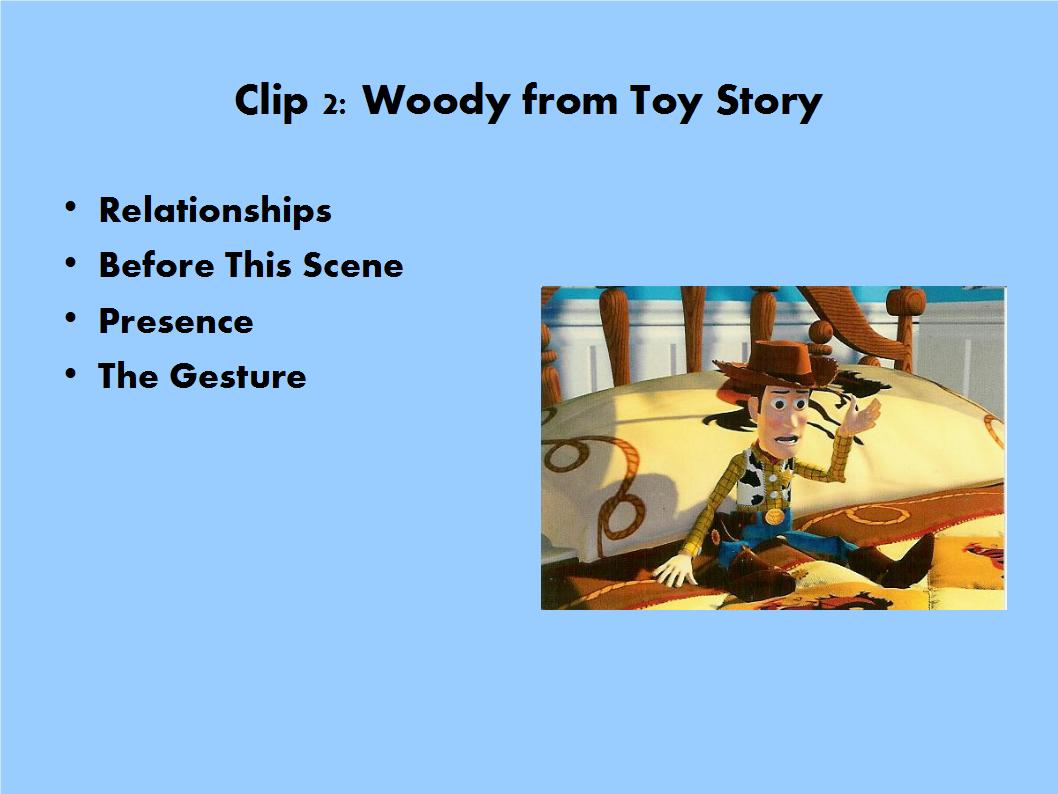
CLIP 2: TOY STORY: WOODY.
*Show clip*
# Relationships - Bo-Peep is Woody's love interest, the feelings are mutual. Buzz and Woody are rivals for Andy's affection.
# Before - What happened before this scene. Woody has seemingly been replaced by Buzz Lightyear as Andy's favourite toy. Woody has just spent the night in the toy chest (previously he would spend nights on Andy's bed) and has just awoken to see Buzz reveal his ink branding given to him by Andy.
# Presence - Woody used to have an important presence in Andy's Room, a sort of leader position. He would call staff meetings and make sure everything is running smoothly. However, since Buzz arrived, Woody's influence seems to be becoming smaller as the toys and Andy pay more attention to Buzz.
# The Gesture - Flustering of the hands. When spoken to by Bo-Peep, he startles and immediately starts looking for a place to put his hands. He speaks calmly but can't get a sentence out, losing control of himself as he seems to have with the situation with Buzz (he has previously tried to downplay Buzz's features and turn the other toys away from him, at which he has failed).
Woody generally over-gestures a lot, in my opinion, particularly when he's angry or frustrated. I don't know if that is intentional as he is a toy but there's not much build up to his big gestures. I suppose this could be considered over gesturing still, as his hands could be making smaller movements. On the other hand though, these are HIS small movements, I think it could be part of his character to move a lot.
The gestures could be bigger though. He could shift his weight more, he could have put his hands near his face or on the back of his neck, he could complete all the gestures he tried to do. He could have acted more startled or obviously bothered instead of as calm as he tried to be.
This gesture reveals the state of his mind when Bo-Peep catches him looking at his shoe. The panic of his hands reflect the panic of his thoughts. His hands trying to find a place to be shows us he is trying to find control of himself and some composure, as to show Bo-Peep he's not 'letting it get to him'.
COMPARISON OF THE CLIPS
# Rivals - The only similarity between these clips is watching a how two different characters deal with a rival. Woody is trying to look cool and not threatened by Buzz, staying in his character. The Joker on the other hand, does not feel threatened and outright kills his rival.
# Control - The scenes were both had an issue of control/dominance. The Joker had control of the scenario. He was not threatened at any point but he did allow himself to release anger in a short, controlled burst. Though it was an explosion of emotion, the Joker did not lose any control over the situation. Refer to presence.
Woody however, has lost control at this point. He ruled the roost previously but now the toys barely hold him in any high regard any more, a few make fun of him to his face. He has lost respect because the toys think he's jealous of Buzz and therefore lost the leadership position he once had. He reflects this by losing control of his body language to Bo-Peep, he doesn't want her to see his weakness. Refer to presence.
IN CONCLUSION: ACTORS VS ANIMATORS
# Preparation - As explained before, Actors use psychological gesture exercises to help them get really into their character, understand their character's psychology. They keep to their character's psychologies and draw gestures from that.
Animators use it much in the same way, though not necessarily through exercises but through sketching and exploring the characters they have to animate.
# Performance - By understanding the characters, particularly the way they think, what they feel and what their objectives are, both Actor and Animators are able to create more powerful performances. Drawing subtle and psychological gestures shows the audience better than they can be told what the character is thinking and feeling.
PSYCHOLOGICAL GESTURE
WHAT IS PSYCHOLOGICAL GESTURE?
# Michael Chekhov - first coined the term. Believes a character's psychology to consists of thoughts, feelings and the will (character's objective and motivation). A psychological gesture is a movement that expresses all of that at once.
# Preparation for Actors - a method to help actors get into character. Remind class of the 'my heart is broken' exercise by Ed Hooks and briefly run through it again. (Was going to have class participation but we did the exercise as a class last week so no need.) Doing this can produce a much more natural and powerful performance.
# Preparation for Animators - as animators, we tend of over-gesture, feeling the need to illustrate every word.
"Gestures do not always have to be illustrations of the spoken word. A gesture can express an inner emotional state that might even be in contrast to what the character is saying. A psychological gesture like this can be a powerful tool." ~ Ed Hooks
By using exercises such as the one from Ed Hooks' Acting for Animators book, animators can really get into the character they're animating and tone down the gestures. Enabling them to animate a not only more convincing character but a much more powerful performance. A small gesture can say much more about what the character is really thinking than a big gesture which can hide it.
# Atmosphere - Michael Chekhov also used atmosphere in a conceptual way. He believed that the atmosphere can affect the kind of gestures a character may make. Different places have different atmospheres (a character would act differently if they were on the scene of an accident to if they were in their best friend's kitchen - their behaviour would adjust). Even people have atmospheres. A happy person can bring a different atmosphere into a room than an angry one. My own dad is an example.
CLIP #1: JACK NICHOLSON: JACK NAPIER/JOKER
*show clip*
# Relationship - Carl Grissom is a crime boss who controls the city. Jack Napier is Carl Grissom's second in command. Jack was having an affair with Carl's mistress.
# Before - what happened before this scene. Jack Napier was set up by his boss (sent him to raid a factory, tipped off the police to get him arrested) over an affair with his mistress. Jack was knocked into a vat of chemicals after being struck in the face by a deflected bullet (deflected by Batman).
# The Presence - Joker blatantly pissed off with boss. Walks towards him in intervals, with one hand behind his back and the other by his side (hands behind back = power and confidence, exposes vulnerable parts. Good for posture and opens up airways = gain more energy, feel more confident). Voice is calm but has venom to it, projected to fill the room.
# The Gesture - A small flick of the arm by his side. He stops walking and tenses a bit. Keeping control of himself and situation, however he allows himself to hit boss with the word. Flick of the arm like a mini-hitting gesture or crack of a whip. Wants to the word to sting, as it stings Jack to know he is being put beneath a woman.
An over gesture, for example, would be to slash at the air (wanting to slash at Carl), point aggressively at Carl (accusing and directing all his anger at him).
Instead, this gesture reveals that Jack is bursting with rage, momentarily betray his calmness up to this point. However, he easily returns to his calm composure which is why I say he 'allows' himself this burst, a moment's divulgance to utter rage. It was probably intentional to make Carl feel threatened.
**EDIT** Added next clip and other half of presentation key points.
CLIP 2: TOY STORY: WOODY.
*Show clip*
# Relationships - Bo-Peep is Woody's love interest, the feelings are mutual. Buzz and Woody are rivals for Andy's affection.
# Before - What happened before this scene. Woody has seemingly been replaced by Buzz Lightyear as Andy's favourite toy. Woody has just spent the night in the toy chest (previously he would spend nights on Andy's bed) and has just awoken to see Buzz reveal his ink branding given to him by Andy.
# Presence - Woody used to have an important presence in Andy's Room, a sort of leader position. He would call staff meetings and make sure everything is running smoothly. However, since Buzz arrived, Woody's influence seems to be becoming smaller as the toys and Andy pay more attention to Buzz.
# The Gesture - Flustering of the hands. When spoken to by Bo-Peep, he startles and immediately starts looking for a place to put his hands. He speaks calmly but can't get a sentence out, losing control of himself as he seems to have with the situation with Buzz (he has previously tried to downplay Buzz's features and turn the other toys away from him, at which he has failed).
Woody generally over-gestures a lot, in my opinion, particularly when he's angry or frustrated. I don't know if that is intentional as he is a toy but there's not much build up to his big gestures. I suppose this could be considered over gesturing still, as his hands could be making smaller movements. On the other hand though, these are HIS small movements, I think it could be part of his character to move a lot.
The gestures could be bigger though. He could shift his weight more, he could have put his hands near his face or on the back of his neck, he could complete all the gestures he tried to do. He could have acted more startled or obviously bothered instead of as calm as he tried to be.
This gesture reveals the state of his mind when Bo-Peep catches him looking at his shoe. The panic of his hands reflect the panic of his thoughts. His hands trying to find a place to be shows us he is trying to find control of himself and some composure, as to show Bo-Peep he's not 'letting it get to him'.
COMPARISON OF THE CLIPS
# Rivals - The only similarity between these clips is watching a how two different characters deal with a rival. Woody is trying to look cool and not threatened by Buzz, staying in his character. The Joker on the other hand, does not feel threatened and outright kills his rival.
# Control - The scenes were both had an issue of control/dominance. The Joker had control of the scenario. He was not threatened at any point but he did allow himself to release anger in a short, controlled burst. Though it was an explosion of emotion, the Joker did not lose any control over the situation. Refer to presence.
Woody however, has lost control at this point. He ruled the roost previously but now the toys barely hold him in any high regard any more, a few make fun of him to his face. He has lost respect because the toys think he's jealous of Buzz and therefore lost the leadership position he once had. He reflects this by losing control of his body language to Bo-Peep, he doesn't want her to see his weakness. Refer to presence.
IN CONCLUSION: ACTORS VS ANIMATORS
# Preparation - As explained before, Actors use psychological gesture exercises to help them get really into their character, understand their character's psychology. They keep to their character's psychologies and draw gestures from that.
Animators use it much in the same way, though not necessarily through exercises but through sketching and exploring the characters they have to animate.
# Performance - By understanding the characters, particularly the way they think, what they feel and what their objectives are, both Actor and Animators are able to create more powerful performances. Drawing subtle and psychological gestures shows the audience better than they can be told what the character is thinking and feeling.
Psychological Gesture 3
It's hard trying to decide on what clips to analyse for this presentation. Especially as I need to find suitable for analysis and comparison.
I've decided to have a look at Jack Nicholson's Jack Napier/Joker character from Batman (1989). The Joker is one of my favourite villians because he's impulsive, unpredictable, obsessive and truly insane. I chose a Jack Nicholson character because it is said his acting is influenced by Michael Chekhov's psychological gesture method.
In the scene I'm about to post, we, the audience, know that Jack Napier (the character Jack Nicholson is playing for that character turns into the Joker) has been set up by his boss, Carl Grissom, over Jack's affair with his mistress. Jack was sent to raid a chemical factory, the police were tipped off and attempt to arrest him. Batman arrives at the scene in his aim to establish himself as a vigilante. He deflects a bullet fired by Jack, which strikes him in the face and knocks him into a huge vat of chemical. Joker later emerges from said vat.
The part of this clip that I want to concentrate on is Jack/Joker's entrance into his now ex-boss' office.
We know that Jack is, understandably, pissed off. The only reason he would be back at the office is for revenge, which is exactly his aim here. He wants to get his own back on Carl for setting him up. This scene is also important as it is the introduction of the Joker, as this will be the first time the audience sees his face after the accident.
So Jack enters the scene. The end of the room he is in is dark. There is light coming from the door behind him and there's light where Carl is standing (other end of the room in front of his desk), however it is not enough to reveal Jack's face. Carl thinks he is someone else, calling them 'sugarbumps' but Jack replies in humour 'It's me, sugarbumps.' Carl recognises Jack's voice and awkwardly feigns relief that he is alive and is about to say what he had heard when Jack finishes the sentence for him with 'Fried?'
Jack is clearly dominating the scene here. He squarely walks closer and closer to Carl every time he speaks. Carl's voice fails him a bit when he tries to say what he has heard so Jack takes up the verbal space by daring to say he was killed with dark humour, filling the mostly empty space between them with confidence and threat. His presense is large and dangerous and growing more so, setting up the audience for a murder scene.
Jack tells Carl what he did - 'You set me up over a woman'. Jack's not asking, he knows Carl was responsible and is telling him. His shadow is increasing in power and dominance. Jack repeats 'woman!' louder and with more venom. He stops walking and flicks his arm slightly as he shouts 'woman!'. The flicking of the arm is the psychological gesture. Jack Nicholson allows his character to unleash his anger for a second but is keeping control of himself and the situation. An over-gesture, for example, would be to have Jack slash the air with the arm by his side or aggressively point at Carl, accusing and directing his anger at him. But instead, Jack flicks his arm as if flicking a small whip; he still wants the word to sting. He still puts the energy he would have used in a more extreme gesture into his voice though, emphasising the word 'woman' ("bro's before hoes" as they say. Either way, jack is clearly angry to be pushed aside as he sees himself being more worthy than said woman, he is the second-in-command after all). He finishes with: 'You must be insane' and chuckles, returning to the tone he had before.
This is all I want to show up to.
Carl tries to gain some power back by drinking his drink and pretending to get another, reaching for his gun. Jack tells him not to bother and pulls out the gun he'd been hiding behind his back the whole time. Carl tries to intimidate Jack and re-gain some power/control by telling him his life isn't even worth spit. Jack calmly replies that he's been killed already and found it rather liberating, downplaying Carl's threat by making it seem a pleasant experience. He takes more steps forward, holding the gun at Carl, swallowing Carl's attempt at a threat. Carl instead tries to bargain with Jack, calling him by his name. Jack merely tells him that Jack is dead and, stepping into the light revealing his face, tells Carl he can call him Joker.
Joker then proceeds to shot Carl over a circus soundtrack. Accomplishing this aim, Joker finds a new one; Batman.
I've decided to have a look at Jack Nicholson's Jack Napier/Joker character from Batman (1989). The Joker is one of my favourite villians because he's impulsive, unpredictable, obsessive and truly insane. I chose a Jack Nicholson character because it is said his acting is influenced by Michael Chekhov's psychological gesture method.
In the scene I'm about to post, we, the audience, know that Jack Napier (the character Jack Nicholson is playing for that character turns into the Joker) has been set up by his boss, Carl Grissom, over Jack's affair with his mistress. Jack was sent to raid a chemical factory, the police were tipped off and attempt to arrest him. Batman arrives at the scene in his aim to establish himself as a vigilante. He deflects a bullet fired by Jack, which strikes him in the face and knocks him into a huge vat of chemical. Joker later emerges from said vat.
The part of this clip that I want to concentrate on is Jack/Joker's entrance into his now ex-boss' office.
We know that Jack is, understandably, pissed off. The only reason he would be back at the office is for revenge, which is exactly his aim here. He wants to get his own back on Carl for setting him up. This scene is also important as it is the introduction of the Joker, as this will be the first time the audience sees his face after the accident.
So Jack enters the scene. The end of the room he is in is dark. There is light coming from the door behind him and there's light where Carl is standing (other end of the room in front of his desk), however it is not enough to reveal Jack's face. Carl thinks he is someone else, calling them 'sugarbumps' but Jack replies in humour 'It's me, sugarbumps.' Carl recognises Jack's voice and awkwardly feigns relief that he is alive and is about to say what he had heard when Jack finishes the sentence for him with 'Fried?'
Jack is clearly dominating the scene here. He squarely walks closer and closer to Carl every time he speaks. Carl's voice fails him a bit when he tries to say what he has heard so Jack takes up the verbal space by daring to say he was killed with dark humour, filling the mostly empty space between them with confidence and threat. His presense is large and dangerous and growing more so, setting up the audience for a murder scene.
Jack tells Carl what he did - 'You set me up over a woman'. Jack's not asking, he knows Carl was responsible and is telling him. His shadow is increasing in power and dominance. Jack repeats 'woman!' louder and with more venom. He stops walking and flicks his arm slightly as he shouts 'woman!'. The flicking of the arm is the psychological gesture. Jack Nicholson allows his character to unleash his anger for a second but is keeping control of himself and the situation. An over-gesture, for example, would be to have Jack slash the air with the arm by his side or aggressively point at Carl, accusing and directing his anger at him. But instead, Jack flicks his arm as if flicking a small whip; he still wants the word to sting. He still puts the energy he would have used in a more extreme gesture into his voice though, emphasising the word 'woman' ("bro's before hoes" as they say. Either way, jack is clearly angry to be pushed aside as he sees himself being more worthy than said woman, he is the second-in-command after all). He finishes with: 'You must be insane' and chuckles, returning to the tone he had before.
This is all I want to show up to.
Carl tries to gain some power back by drinking his drink and pretending to get another, reaching for his gun. Jack tells him not to bother and pulls out the gun he'd been hiding behind his back the whole time. Carl tries to intimidate Jack and re-gain some power/control by telling him his life isn't even worth spit. Jack calmly replies that he's been killed already and found it rather liberating, downplaying Carl's threat by making it seem a pleasant experience. He takes more steps forward, holding the gun at Carl, swallowing Carl's attempt at a threat. Carl instead tries to bargain with Jack, calling him by his name. Jack merely tells him that Jack is dead and, stepping into the light revealing his face, tells Carl he can call him Joker.
Joker then proceeds to shot Carl over a circus soundtrack. Accomplishing this aim, Joker finds a new one; Batman.
Wednesday, 29 February 2012
Psychological Gesture 2
Yesterday, our tutor touched on psychological gesture in her tutorial.
It pretty much confirmed what I thought it might have been in a post or two ago.
Actors use psychological gesture to help them get into the role of the character they are playing. They do it through exercises such as the Ed Hooks one I put in the previous post.
As animators, we tend to over gesture (I am very guilty of this) so using psychological gestures helps us tone down the animation and get the essence of the performance into it instead.
For the two clips I need for my presentation, I'm actually thinking of using one of my previous animations where over gesturing was particularly bad (as animated clip) and either shooting another reference shot of what it could have been using psychological gesture or finding the original clip that shows the acting with the audio clip I used. I'll have to find the original clip first so I'll have to ask our previous tutor if she remembers where she got it.
It pretty much confirmed what I thought it might have been in a post or two ago.
Actors use psychological gesture to help them get into the role of the character they are playing. They do it through exercises such as the Ed Hooks one I put in the previous post.
As animators, we tend to over gesture (I am very guilty of this) so using psychological gestures helps us tone down the animation and get the essence of the performance into it instead.
For the two clips I need for my presentation, I'm actually thinking of using one of my previous animations where over gesturing was particularly bad (as animated clip) and either shooting another reference shot of what it could have been using psychological gesture or finding the original clip that shows the acting with the audio clip I used. I'll have to find the original clip first so I'll have to ask our previous tutor if she remembers where she got it.
Saturday, 25 February 2012
Psychological Gesture
Is confusing.
I've been reading/watching bits and pieces of the internet, looking through books and researching the man that coined the term 'Psychological Gesture' and it's still pretty difficult to understand.
However, I'm going to give it a shot.
It was Michael Chekhov that first coined the term 'psychological gesture. He was a Russian-American actor, author, director and theatre practitioner. He wrote a book called On The Technique of Acting in which he describes his acting techniques. PG seems to be one way of helping the actor (or actress) explore their character and act mannerisms and such with accordance. His techniques have been used by actors/actress' such as Marilyn Monroe and Clint Eastwood and his work has influenced actors Jack Nicholson, Johnny Depp and Anthony Hopkins.
Ed Hooks' book Acting for Animators explains that "Gestures do not always have to be illustrations of the spoken word. A gesture can express an inner emotional state that might even be in contrast to what the character is saying. A psychological gesture like this can be a powerful tool."
A human's sense of sight is much more sensitive (and therefore powerful) than its sense of hearing, so it is important to consider what to show the audience more than what you tell them.
Ed Hooks also says that "new animators too often create over-gesticulation because they are trying to put a gesture with every single word. This puts dialogue on a pedestal that it really does not deserve". I am completely guilty of this and I understand why my tutor thought it would be good for me to research. And I agree, I do need to use less big gestures and I think I need to really consider the subtle and psychological gestures that a character can show to enhance his performance rather than using big gestures to illustrate what he's saying. Basically I need to think about what the character is thinking and they're really feeling on the inside.
"One important question is whether the PG is ever visible to the audience. Chekhov's writings often suggest that it should be invisible, although this appears to some extent to depend on the style of performance undertaken, and Chekhov uses the term to refer to 'visible (actual) gestures as well as to invisible (potential) gestures'." ~ 'Michael Chekhov', Franc Chamberlain.
So a psychological gesture can really be anything a character does that reflects his/her wants, thoughts and feelings. It includes body language. Ed Hooks says "Have you ever noticed someone who wrings their hands a lot while talking? That's a psychological gesture. A bully who punches someone in the chest with his finger? That's a psychological gesture." He mentions that Gollum from 'Lord of the Rings' is constantly making psychological gestures and that this may be because Andy Serkis (the actor that played him) is classically trained.
Here are some videos I found on Youtube that talk about Andy Serkis and his performances as Gollum:
Gollum has a lot of idiosyncrasies (peculiar behaviour of a character, could be called odd habits or quirks) and speaks with illeism (refers to himself in the third person). Schizophrenic is not quite the right description of his mental state as schizophrenic people do not have split personalities, that is Multiple Personality Disorder (or DID - Dissociative Identity Disorder). Andy Serkis describes Gollum as two personalities, Smeagol who is happy, trusting and whimsical and Gollum who is the hard survivor and makes Smeagol feel small and weak. They conflict with each other with Gollum usually winning because they need to survive and Smeagol doesn't have the strength in him to lead. Though (from what I know of, I'm not a doctor and what I say may not be 100% - Disclaimer!) it's still not quite Multiple Personality Disorder, Andy has used these influences to portray Gollum's mental distress and inner conflict through adopting some mannerisms that schizophrenic and DID people sometimes display.
In the particular scene they talk about in the videos, Gollum is arguing with himself. Or rather Smeagol is arguing with Gollum. They differentiate the personalities not only by the performance but by the camera angle too. One side is Smeagol and the other is Gollum. The character literally swings between personalities using his head which could be considered a psychological gesture as its not only showing the audience who is talking but that the character is disturbed and believing he is seeing and talking to another. The performance is enhanced by the two personalities' performances. Smeagol's mannerism are lighter and positive. His facial expressions range between really happy, upset or distressed but always gentle and his pupils are generally more dilated making him appear 'cuter'. Gollum is cruel, sharp and harsh, his pupils are noticeably smaller which gives him a fierce and piercing stare that frightens Smeagol. He usually holds himself up above the level Smeagol usually holds himself to maintain dominance until Smeagol gains confidence and therefore control.
Ed Hooks also mentioned Wybie from Coraline having a lot of psychological gestures, mostly a mix of self doubt and uncertainty:
Psychological gestures can also be verbal. Ed Hooks describes an exercise to demonstrate this:
"Consider the word 'broken' in the sentence 'My heart is broken.' If you had to non-verbally express the feeling behind that word, what would you do?... I'm talking about how the word 'broken' feels. With your hands down by your side - no gesture at all - say that line out loud: 'My heart is broken.'... Now, with no words, pretend you are forcefully breaking a stick with your hands. Can you feel the underlying impulse? do not break the stick simply because I told you to. Break it on your own, perhaps starting with the impulse that springs from the pain of a personal loss. Break it out of exasperation or frustration... Now, once again say the line aloud, breaking the stick simultaneously. Get the stick to break at the precise moment you say the word 'broken'. Notice how much stronger the line sounds, how much more powerful it feels? Now, try speaking the line aloud while breaking the stick internally. You can do anything with your hands except break the stick. The line will be stronger than it was the first time you said it aloud. Amazing, huh?"
Yes I tried this exercise myself and believe I see (or hear!) the difference. I may steal this exercise for my presentation on this subject as it might be more interesting and easier to understand.
So in conclusion, psychological gestures are effectively mannerisms of a character. They can be anything that reflects the inner thoughts and feelings of a character from a physical gesture, like covering your mouth with your hand, to subtle gestures such as someone's eyes briefly flicking away and returning to someone they've just lied to, to a verbal gesture like the one just described above. They can strengthen what a character is saying or conflict with it.
Phew! Long post is long!
Books Used:
Acting Characters: Simple Steps... Paul Elsam
Acting Characters: Essential Steps... Paul Elsam
Michael Chekhov... Frank Chamberlain
I've been reading/watching bits and pieces of the internet, looking through books and researching the man that coined the term 'Psychological Gesture' and it's still pretty difficult to understand.
However, I'm going to give it a shot.
It was Michael Chekhov that first coined the term 'psychological gesture. He was a Russian-American actor, author, director and theatre practitioner. He wrote a book called On The Technique of Acting in which he describes his acting techniques. PG seems to be one way of helping the actor (or actress) explore their character and act mannerisms and such with accordance. His techniques have been used by actors/actress' such as Marilyn Monroe and Clint Eastwood and his work has influenced actors Jack Nicholson, Johnny Depp and Anthony Hopkins.
Ed Hooks' book Acting for Animators explains that "Gestures do not always have to be illustrations of the spoken word. A gesture can express an inner emotional state that might even be in contrast to what the character is saying. A psychological gesture like this can be a powerful tool."
A human's sense of sight is much more sensitive (and therefore powerful) than its sense of hearing, so it is important to consider what to show the audience more than what you tell them.
Ed Hooks also says that "new animators too often create over-gesticulation because they are trying to put a gesture with every single word. This puts dialogue on a pedestal that it really does not deserve". I am completely guilty of this and I understand why my tutor thought it would be good for me to research. And I agree, I do need to use less big gestures and I think I need to really consider the subtle and psychological gestures that a character can show to enhance his performance rather than using big gestures to illustrate what he's saying. Basically I need to think about what the character is thinking and they're really feeling on the inside.
"One important question is whether the PG is ever visible to the audience. Chekhov's writings often suggest that it should be invisible, although this appears to some extent to depend on the style of performance undertaken, and Chekhov uses the term to refer to 'visible (actual) gestures as well as to invisible (potential) gestures'." ~ 'Michael Chekhov', Franc Chamberlain.
So a psychological gesture can really be anything a character does that reflects his/her wants, thoughts and feelings. It includes body language. Ed Hooks says "Have you ever noticed someone who wrings their hands a lot while talking? That's a psychological gesture. A bully who punches someone in the chest with his finger? That's a psychological gesture." He mentions that Gollum from 'Lord of the Rings' is constantly making psychological gestures and that this may be because Andy Serkis (the actor that played him) is classically trained.
Here are some videos I found on Youtube that talk about Andy Serkis and his performances as Gollum:
Gollum has a lot of idiosyncrasies (peculiar behaviour of a character, could be called odd habits or quirks) and speaks with illeism (refers to himself in the third person). Schizophrenic is not quite the right description of his mental state as schizophrenic people do not have split personalities, that is Multiple Personality Disorder (or DID - Dissociative Identity Disorder). Andy Serkis describes Gollum as two personalities, Smeagol who is happy, trusting and whimsical and Gollum who is the hard survivor and makes Smeagol feel small and weak. They conflict with each other with Gollum usually winning because they need to survive and Smeagol doesn't have the strength in him to lead. Though (from what I know of, I'm not a doctor and what I say may not be 100% - Disclaimer!) it's still not quite Multiple Personality Disorder, Andy has used these influences to portray Gollum's mental distress and inner conflict through adopting some mannerisms that schizophrenic and DID people sometimes display.
In the particular scene they talk about in the videos, Gollum is arguing with himself. Or rather Smeagol is arguing with Gollum. They differentiate the personalities not only by the performance but by the camera angle too. One side is Smeagol and the other is Gollum. The character literally swings between personalities using his head which could be considered a psychological gesture as its not only showing the audience who is talking but that the character is disturbed and believing he is seeing and talking to another. The performance is enhanced by the two personalities' performances. Smeagol's mannerism are lighter and positive. His facial expressions range between really happy, upset or distressed but always gentle and his pupils are generally more dilated making him appear 'cuter'. Gollum is cruel, sharp and harsh, his pupils are noticeably smaller which gives him a fierce and piercing stare that frightens Smeagol. He usually holds himself up above the level Smeagol usually holds himself to maintain dominance until Smeagol gains confidence and therefore control.
Ed Hooks also mentioned Wybie from Coraline having a lot of psychological gestures, mostly a mix of self doubt and uncertainty:
Psychological gestures can also be verbal. Ed Hooks describes an exercise to demonstrate this:
"Consider the word 'broken' in the sentence 'My heart is broken.' If you had to non-verbally express the feeling behind that word, what would you do?... I'm talking about how the word 'broken' feels. With your hands down by your side - no gesture at all - say that line out loud: 'My heart is broken.'... Now, with no words, pretend you are forcefully breaking a stick with your hands. Can you feel the underlying impulse? do not break the stick simply because I told you to. Break it on your own, perhaps starting with the impulse that springs from the pain of a personal loss. Break it out of exasperation or frustration... Now, once again say the line aloud, breaking the stick simultaneously. Get the stick to break at the precise moment you say the word 'broken'. Notice how much stronger the line sounds, how much more powerful it feels? Now, try speaking the line aloud while breaking the stick internally. You can do anything with your hands except break the stick. The line will be stronger than it was the first time you said it aloud. Amazing, huh?"
Yes I tried this exercise myself and believe I see (or hear!) the difference. I may steal this exercise for my presentation on this subject as it might be more interesting and easier to understand.
So in conclusion, psychological gestures are effectively mannerisms of a character. They can be anything that reflects the inner thoughts and feelings of a character from a physical gesture, like covering your mouth with your hand, to subtle gestures such as someone's eyes briefly flicking away and returning to someone they've just lied to, to a verbal gesture like the one just described above. They can strengthen what a character is saying or conflict with it.
Phew! Long post is long!
Books Used:
Acting Characters: Simple Steps... Paul Elsam
Acting Characters: Essential Steps... Paul Elsam
Michael Chekhov... Frank Chamberlain
Monday, 12 December 2011
Other research for AP2 Presentation
Here are some extra things I looked into to put into the presentation.
The two screen caps below are when I was looking at camera movement and then later Arcs. I tried to building the scene in which the camera moved to follow Toothless' movement. I also traced the arcs that Toothless moved in. I believe this was done to give him the movement of a feline predator (makes sense if we consider the rumour about his movement being based on an alleged domesticated mountain lion). It makes the switch to puppy eyed dragon much more apparent.
I was looking at the line of action here to demonstrate that the focus is on Toothless in these shots. We can see Hiccup leading the eye by offering the fish to Toothless.
AP2 Presentation: Scene Analysis
Here is my presentation for tomorrow. I'm hoping it will go well. I'm mostly hoping I'll be able to hold my composure as last time I got flustered and rushed a bit (or at least I felt I did - still waiting on feedback on the first module). I enjoyed watching the crap out of this movie, looking for what scene I wanted to analyse :)
Wednesday, 7 December 2011
How To Train Your Dragon: Clip
Here is the CLIP I'm analysing for my presentation. I cannot embed this due to copyright.
Tuesday, 6 December 2011
How To Train Your Dragon: Research 2
Here are scans from the book I've been referring to about camera layouts and shots for the previous post. The book can be found HERE!
The book focuses on all aspects of animation production rather than just the animation. I read through these sections to refresh my memory on camera layouts, scene planning, types of shots and the rule of thirds. I then applied what I learned to analyse the clip I'm showing for my presentation. Speaking of which, I will upload that clip very soon.
Monday, 5 December 2011
How To Train Your Dragon: Camera
In the clip I'm analysing, only 3 shots are used:
The first one is a long shot of Toothless (his full body is in shot) with selective focus (Hiccup is slightly out of focus). It is clear in this shot that the audience should be focusing on Toothless and his reaction to Hiccup.
The second is a medium shot of Hiccup (shows him from waist up) to focus on his reactions and thinking. He's playing a bit of a dangerous game here by standing face to face with a dragon and the audience needs to see how he reacts and what he's thinking. This shot allows the audience to focus on his facial expressions and actions with the fish when necessary.
The third is another long shot but of Hiccup (full body in shot). It's a longer shot than normal because of the space left around Hiccup's body. It's not enough to be an extreme shot but it establishes something important to the audience; how in the open Hiccup is. This shot is used when Hiccup is forced to drop his knife away from his body. Being out in the open with a dragon is dangerous enough but this shot emphasises how Hiccup, on the act of throwing away the knife, is truly alone with nowhere to run and now completely defenseless.
There could be a fourth shot, which is the slight close up on Hiccup's face (from shoulders up). This is only used once in this clip to really focus on Hiccup's response to Toothless' disapproval of him having the knife. His facial expressions are key to his thoughts. In this shot we can see that he decides, knowing its dangerous, to throw it away.
The shots are kept minimal and simple. There is no dialogue in this scene but there is a 'conversation' between the two characters through body language alone, which is why it is important to have Toothless' whole body in shot. The cuts in this scene are timed so that after a character does his action, we see the other character's responding action and then back again to see the first character's response to that, creating this 'conversation'.
The main focus here is on the characters building a relationship.
The rule of thirds is used in this clip to keep the shots interesting but more importantly to clearly show that these characters are interacting by spacing them appropriately when both in shot at the same time.
Toothless is never shown alone in the shot, Hiccup is always out of focus in the foreground. However, Hiccup is shown in shot alone but slightly off centre towards to left. He is always looking at something downwards towards the right. I think this is intentional because if Toothless was kept in the shot there wouldn't be enough focus on Hiccup and his responses and thoughts.
In this last screen capture he is a bit farther on the left. He is still looking at something downward towards the right. With all the space around him. he is giving the impression that the character on the other side of the conversation is the dominant one and making him feel small. He does look quite small in that shot!
The first one is a long shot of Toothless (his full body is in shot) with selective focus (Hiccup is slightly out of focus). It is clear in this shot that the audience should be focusing on Toothless and his reaction to Hiccup.
The second is a medium shot of Hiccup (shows him from waist up) to focus on his reactions and thinking. He's playing a bit of a dangerous game here by standing face to face with a dragon and the audience needs to see how he reacts and what he's thinking. This shot allows the audience to focus on his facial expressions and actions with the fish when necessary.
The third is another long shot but of Hiccup (full body in shot). It's a longer shot than normal because of the space left around Hiccup's body. It's not enough to be an extreme shot but it establishes something important to the audience; how in the open Hiccup is. This shot is used when Hiccup is forced to drop his knife away from his body. Being out in the open with a dragon is dangerous enough but this shot emphasises how Hiccup, on the act of throwing away the knife, is truly alone with nowhere to run and now completely defenseless.
There could be a fourth shot, which is the slight close up on Hiccup's face (from shoulders up). This is only used once in this clip to really focus on Hiccup's response to Toothless' disapproval of him having the knife. His facial expressions are key to his thoughts. In this shot we can see that he decides, knowing its dangerous, to throw it away.
The shots are kept minimal and simple. There is no dialogue in this scene but there is a 'conversation' between the two characters through body language alone, which is why it is important to have Toothless' whole body in shot. The cuts in this scene are timed so that after a character does his action, we see the other character's responding action and then back again to see the first character's response to that, creating this 'conversation'.
The main focus here is on the characters building a relationship.
The rule of thirds is used in this clip to keep the shots interesting but more importantly to clearly show that these characters are interacting by spacing them appropriately when both in shot at the same time.
Toothless is never shown alone in the shot, Hiccup is always out of focus in the foreground. However, Hiccup is shown in shot alone but slightly off centre towards to left. He is always looking at something downwards towards the right. I think this is intentional because if Toothless was kept in the shot there wouldn't be enough focus on Hiccup and his responses and thoughts.
In this last screen capture he is a bit farther on the left. He is still looking at something downward towards the right. With all the space around him. he is giving the impression that the character on the other side of the conversation is the dominant one and making him feel small. He does look quite small in that shot!
Sunday, 4 December 2011
How To Train Your Dragon: Research 1
Found some wonderful artwork by character designer Nicolas Marlet and various other artists that worked on the concept art of How To Train Your Dragon on another blog I follow: Here
The blog is called Living Lines Library and has lots of concept art, animation tests, storyboards and more from all sorts of animated movies.
There are also lots of interviews with various people that worked on the film on Dreamworks' YouTube Channel.
Also found a rumour (I say rumour because I can't find any evidence to support it) that a domesticated mountain lion owned by the one of the directors' (Dean BeBlois) uncle was the inspiration for they way Toothless moves! Found on wikipedia, under the Development section.
Production development blog for How To Train Your Dragon.
The blog is called Living Lines Library and has lots of concept art, animation tests, storyboards and more from all sorts of animated movies.
There are also lots of interviews with various people that worked on the film on Dreamworks' YouTube Channel.
Also found a rumour (I say rumour because I can't find any evidence to support it) that a domesticated mountain lion owned by the one of the directors' (Dean BeBlois) uncle was the inspiration for they way Toothless moves! Found on wikipedia, under the Development section.
Production development blog for How To Train Your Dragon.
AP2 Presentation: How To Train Your Dragon
I already knew that I wanted to present a clip from How To Train Your Dragon but which part I didn't know. I've been watching it again and again and parts of it again and again and I think I've decided which clip I want to have.
It's hard to find the clip on the internet so I will have to make one myself but it's on this video that someone has compiled themselves on youtube (I truly hate these kinds of youtube videos but nevermind..): Check it out
Clip is roughly 0.33 to 0.55.
I will upload a better clip soon.
Previously, Hiccup decided to release the dragon instead of achieving his goal up to that point (which was to kill a dragon and be finally recognised as Viking and not useless). Interestingly the dragon, straight after being released, also decided not to kill Hiccup. They both had an easy chance of killing each other but did not take it.
The second time they see each other is from afar. Hiccup is on a rocky edge watching the dragon struggle to get out of the dipped area surrounded by rock, trying to figure out why it won't fly away. The dragon only becomes aware of Hiccup's presence when he drops his pencil down into the area. It is also shown at this point that the dragon is unable to catch its own food when it fails to catch fish in the water. Hiccup and the dragon only gaze at each other from their places but nothing more, showing no bad intentions towards the other.
What I really like about this scene (the clip I'm analysing) is it is the first time Hiccup and Toothless have been face to face and in front of each other since when Hiccup released Toothless (though 3rd time they have seen each other, counting the moment of release). So by going right into the area where the dragon is currently trapped in (a very open area with very high walls of rock and little place to hide or escape through) is very dangerous.
The clip starts with Toothless slinking down from a high rock he had been watching Hiccup from, moving very cat-like. It is clear that he does not welcome Hiccup until he sees something he wants; the fish. He does not immediately approach Hiccup for it. He is still very suspicious and cautious and keeps low to the ground. A cat behaving like this would mean it is frightened and would attack if necessary, the same can be assumed for Toothless here. Hiccup, though obvious very scared, offers the fish immediately at arms length, tilting his head away in fear that the dragon may bite off more than the fish. Toothless, slowly and cautiously, moves towards the fish, putting one of his bad legs out first and following with his front. He almost takes it when he suddenly looks at Hiccup's waist and draws back growling. Hiccup seems to know immediately what has upset the dragon as he opens his fur jacket to reveal a knife. Touching it confirms that Toothless does not like it and won't approach him with it there. Hiccup drops the knife at arms length to his side but this isn't good enough for Toothless who flicks his head to one side, still looking at the knife. Hiccup flips the knife onto his foot and kicks it further to the side, we hear water splashing and can assume it is no where within reach now. Toothless, appeased, shows his approval by sitting up like a dog with huge eyes. This is not the first time his eyes have been bigger than usual but this is the first time he has looked cute with them.
Watching the wordless communication here is interesting as Hiccup seems to pick up exactly what the dragon is thinking, perhaps illustrating the first time a Viking has actually paid observing attention to a dragon without the intention of killing it but to understand it. This is the first 'conversation' as such between Hiccup and Toothless, presenting the idea of a bond that could possibly happen between them. It is evident that they are both curious about each other (Toothless not so much right now but he is still cautious with Hiccup at this point). Toothless shows intelligence in the way he directs Hiccup to get rid of the knife and it is established this way that they are able to understand each other, again opening a way for a possible bond.
It's hard to find the clip on the internet so I will have to make one myself but it's on this video that someone has compiled themselves on youtube (I truly hate these kinds of youtube videos but nevermind..): Check it out
Clip is roughly 0.33 to 0.55.
I will upload a better clip soon.
Previously, Hiccup decided to release the dragon instead of achieving his goal up to that point (which was to kill a dragon and be finally recognised as Viking and not useless). Interestingly the dragon, straight after being released, also decided not to kill Hiccup. They both had an easy chance of killing each other but did not take it.
The second time they see each other is from afar. Hiccup is on a rocky edge watching the dragon struggle to get out of the dipped area surrounded by rock, trying to figure out why it won't fly away. The dragon only becomes aware of Hiccup's presence when he drops his pencil down into the area. It is also shown at this point that the dragon is unable to catch its own food when it fails to catch fish in the water. Hiccup and the dragon only gaze at each other from their places but nothing more, showing no bad intentions towards the other.
What I really like about this scene (the clip I'm analysing) is it is the first time Hiccup and Toothless have been face to face and in front of each other since when Hiccup released Toothless (though 3rd time they have seen each other, counting the moment of release). So by going right into the area where the dragon is currently trapped in (a very open area with very high walls of rock and little place to hide or escape through) is very dangerous.
The clip starts with Toothless slinking down from a high rock he had been watching Hiccup from, moving very cat-like. It is clear that he does not welcome Hiccup until he sees something he wants; the fish. He does not immediately approach Hiccup for it. He is still very suspicious and cautious and keeps low to the ground. A cat behaving like this would mean it is frightened and would attack if necessary, the same can be assumed for Toothless here. Hiccup, though obvious very scared, offers the fish immediately at arms length, tilting his head away in fear that the dragon may bite off more than the fish. Toothless, slowly and cautiously, moves towards the fish, putting one of his bad legs out first and following with his front. He almost takes it when he suddenly looks at Hiccup's waist and draws back growling. Hiccup seems to know immediately what has upset the dragon as he opens his fur jacket to reveal a knife. Touching it confirms that Toothless does not like it and won't approach him with it there. Hiccup drops the knife at arms length to his side but this isn't good enough for Toothless who flicks his head to one side, still looking at the knife. Hiccup flips the knife onto his foot and kicks it further to the side, we hear water splashing and can assume it is no where within reach now. Toothless, appeased, shows his approval by sitting up like a dog with huge eyes. This is not the first time his eyes have been bigger than usual but this is the first time he has looked cute with them.
Watching the wordless communication here is interesting as Hiccup seems to pick up exactly what the dragon is thinking, perhaps illustrating the first time a Viking has actually paid observing attention to a dragon without the intention of killing it but to understand it. This is the first 'conversation' as such between Hiccup and Toothless, presenting the idea of a bond that could possibly happen between them. It is evident that they are both curious about each other (Toothless not so much right now but he is still cautious with Hiccup at this point). Toothless shows intelligence in the way he directs Hiccup to get rid of the knife and it is established this way that they are able to understand each other, again opening a way for a possible bond.
Wednesday, 12 October 2011
Presentation: Follow Through and Overlapping Action
I gave my presentation today on my given subject which was 'Follow Through and Overlapping Action'. The presentation was to last a maximum of ten minutes, of which I think mine lasted 3 or 4 minutes. I also ended up using the two videos I found and posted in the previous post (Digital tutors and Disney's Tangled).
I have added the notes that I had put into powerpoint below each slide.
Slide 1: No Notes
Slide 2:
Nothing all moves at once. When we move ourselves, everything has its own arcs and speed.
Basically means “One part starts first and other parts follow” ~ Richard Williams – The Animator’s Survival Kit.
Overlapping action can effect clothes, hair and loose skin. Can even effect limbs, depending on the pose or action. (Weighting on loose skin can also be referred to as ‘Drag’.)
Picture of Rapunzel and Flynn (Glenn Kean doodle – Disney’s Tangled): If Rapunzel here were to take off running, her skirt would fall behind a few frames due to being effected by Rapunzel’s movement but not an actual part of the action. Same with her hair, some of it will lag behind and fly around behind her. However, due to its length and weight, not all of it will follow suit and drag along the floor.
Slide 3:
Works the same way as overlapping action but opposite. Everything does not start at once, so nothing stops at once either.
Can also effect clothes, hair, loose skin and even limbs. Again depending on the action and weight.
Picture of simple man with javelin (http://www.animationbrain.com/follow-through-overlapping-2d-animation-principle.html):
After man has completed action (when the javelin has left his hand) the energy does not just disappear, he must follow through. It would look very unnatural if he didn’t and would take away the weight and life out of the animation. Follow through can be done a few different ways. For example, in the picture the man just follows the weight shift and his arm continues slightly. This could be taken to a more humorous level by exaggerating the action which may cause him to fall head over heels following the weight shift.
Slide 4:
Explain pic (from Richard Williams’ The Animator’s Survival Kit)
The starting movement and main action is the turning of the dog’s head. His jowls follow soon after the main action is made. Due to the weight of his loose skin, the jowls ‘drag’ back a little bit/few frames. This gives the sense of weight and realness to the character.
When his head stops, the rest of his skin does not stop at the same time. It still needs to catch up. It should still be lagging behind a bit at this point.
Everything now follows through and rushes forward. This could be taken to a humorous level with some added squash and stretch or exaggeration but here it is simply thrown forward.
The loose skin will catch up and settle back into a resting position. It may swing slightly as it does so.
PUTTING THEM TOGETHER CREATES AN ANIMATION THAT IS FULL OF LIFE AND NATURAL.
Slide 5:
Video 1: Digital Tutors: Follow Through and Overlapping Action
http://www.youtube.com/watch?v=Y2wJA9eX3yA
Video 2: Rapunzel’s Hair
http://www.youtube.com/watch?v=7Zh-0dRS-4U
Slide 6: No Notes
I am now waiting for feedback on how I did.
Personally, I'm not really happy with how I handled myself. I think I may have rushed a little bit (due to nerves and other stresses at home) and I quickly noticed while watching other presentations that I had forgotten to reference my images and videos on the presentation! I think I could have constructed a better presentation.
Hopefully I will get another chance to do another one where I will be able to improve and make less mistakes!
Follow Through and Overlapping Action: Research 2
I've been trying to think of a good 3D example of follow through and overlapping action. Can't believe it took me so long to think of Disney's Tangled!!
Her hair is a signature part of the Rapunzel as well as an extension of her character so it was vital they got it right. The way she throws it around and uses it requires plenty of overlapping action and follow through. Take this video as an example. When she travels down her own hair she's going so fast she almost leaves part of her own hair in the dust! And when she suddenly stops just before touching the ground, the weight and 'realness' is portrayed very nicely in the follow through.
I also found this digital tutors video on follow through and overlapping action. It shows the principle very clearly using a 3D rope. This will be quite handy for the presentation and the pendulum assignment.
Friday, 7 October 2011
Follow Through and Overlapping Action: Research
For my animation principles presentation on the 12th, I have to focus on 'Follow Through' and 'Overlapping Action'.
Everything doesn't move at the same time. A character does not stop after finishing an action and then move to do the next. Hair, ears or loose skin, for example, will fall behind a few frames due to only being attached to the main action rather than part of it. How it moves depends on other principles such as weight, sometimes referred to as 'Drag'. This is overlapping action.
To 'Follow Through' basically refers to the movement following a main action. For example, when a character stops moving, everything doesn't stop at once. Any clothes, loose skin, hair or even limbs make take a few frames to catch up and reach their stopping point because they may move individually to the skeleton.
Here is a short, simple video on this principle:
I also looked up the principle in 'The Illusion of Life: Disney Animation' by Frank Thomas and Ollie Johnston:
I watched 'Mickey's Grand Opera', particularly Donald Duck's movement (though the principle is present in all the characters shown) and you can see that though he holds his position sometimes he doesn't actually stop moving. His arms are usually doing different things from each other and his legs are walking this way and that. By following this principle his movement is much more life-like, or more accurate to how movement works in real life.
Richard Williams' 'The Animator's Survival Kit' very simple but effectively explains Follow Through and Overlapping Action:
For my presentation, I am thinking of including this particular image to illustrate the principle. I have added my own notes over the image below to show the flow of movement. I may draw over the clean image in my presentation as I think that would be the most effective and interesting way to explain the principle.
References in order:
# Animation Training Video. Linked from Youtube, created by http://www.animatortraining.com
# Pages from 'The Illusion of Life: Disney Animation' by Frank Thomas and Ollie Johnston.
# 'Mickey Mouse: Mickey's Grand Opera' video. Linked from Youtube, created by Disney, 1936.
# Pages from 'The Animator's Survival Kit' by Richard Williams.
Everything doesn't move at the same time. A character does not stop after finishing an action and then move to do the next. Hair, ears or loose skin, for example, will fall behind a few frames due to only being attached to the main action rather than part of it. How it moves depends on other principles such as weight, sometimes referred to as 'Drag'. This is overlapping action.
To 'Follow Through' basically refers to the movement following a main action. For example, when a character stops moving, everything doesn't stop at once. Any clothes, loose skin, hair or even limbs make take a few frames to catch up and reach their stopping point because they may move individually to the skeleton.
Here is a short, simple video on this principle:
I also looked up the principle in 'The Illusion of Life: Disney Animation' by Frank Thomas and Ollie Johnston:
I watched 'Mickey's Grand Opera', particularly Donald Duck's movement (though the principle is present in all the characters shown) and you can see that though he holds his position sometimes he doesn't actually stop moving. His arms are usually doing different things from each other and his legs are walking this way and that. By following this principle his movement is much more life-like, or more accurate to how movement works in real life.
Richard Williams' 'The Animator's Survival Kit' very simple but effectively explains Follow Through and Overlapping Action:
For my presentation, I am thinking of including this particular image to illustrate the principle. I have added my own notes over the image below to show the flow of movement. I may draw over the clean image in my presentation as I think that would be the most effective and interesting way to explain the principle.
References in order:
# Animation Training Video. Linked from Youtube, created by http://www.animatortraining.com
# Pages from 'The Illusion of Life: Disney Animation' by Frank Thomas and Ollie Johnston.
# 'Mickey Mouse: Mickey's Grand Opera' video. Linked from Youtube, created by Disney, 1936.
# Pages from 'The Animator's Survival Kit' by Richard Williams.
Subscribe to:
Posts (Atom)